

How IAMX Maps to the Value Acceleration Methodology™ (VAM)
The Strategic Framework Behind the CEPA (Certified Exit Planning Advisor) Designation from the Exit Planning Institute
A few weeks ago, Andy Esser — a wealth advisor and CEPA whose values-based approach to exit planning reflects the best of what this profession can be — asked a direct question: “How does IAMX map to the CEPA Value Acceleration Methodology (VAM)?”
It was an honest request. Not skeptical or critical. He wanted to understand whether there was a coherent connection between the strategic architecture of the Value Acceleration Methodology™ and the human-first leadership work that IAMX does with growth-stage companies.
This article is the answer to that question.
A Framework Honest Enough to Name Its Own Gap
The Value Acceleration Methodology™ is one of the most complete exit frameworks ever built. Its core insight — that exit readiness is a living process, not a single event — is both practically and philosophically sound. The Three Legs of the Stool, the Five Stages of Value Maturity, the Four Intangible Capitals, the Three Gates: each concept is rigorous, well-tested, and built to serve the whole person, not just the transaction.
What makes the VAM unusually credible is that it is honest about where it is most vulnerable. The methodology itself says:
• 70% of owners regret selling within a year — most often because they had no personal identity beyond the business
• The Personal Leg of the stool is “the most overlooked”
• Intangible capitals make up roughly 80% of a business’s value — yet are the hardest to build and transfer
• Owner-dependent businesses “will never reach full value potential”
• Cultural alignment can be a “deal killer” during third-party sales
• The emotional dimension of exit is a critical risk factor — one that requires more than a personal financial plan
These are not footnotes. They are central claims in the methodology. Every one of them is a human problem.
Human problems require a human methodology.
The Gap in the Ecosystem
Naming a problem and solving it are different things. The VAM gives advisors a precise strategic map. What it was never designed to provide is a methodology for developing the human terrain that map describes.
This is not a criticism of the VAM. It is an observation about the ecosystem around it. A CEPA working inside the framework knows when an owner’s leadership bench is thin, when the culture is too personality-dependent to survive a transition, when a founder’s identity is fused with the business. What’s less clear is what to do next. Who develops the leaders? Who untangles the owner from the organization? Who prepares the person, not just the plan?
That is where IAMX operates.
What IAMX Is
IAMX is a human-first executive leadership and organizational transformation consultancy. Founded by Karen Tax — a computer scientist with a master’s degree in organizational development and 25 years of experience with growth-stage companies — IAMX works primarily with technically-minded founders and executives in growth-stage companies in the $1M–$100M revenue range, typically 20–500 people, navigating the terrain between founder-led operations and scalable, transferable enterprise.
The core thesis: the bottleneck in most scaling organizations is not a lack of systems — it’s that existing systems optimize processes, not people. Add more frameworks and metrics without addressing the humans running them, and the result is more coordination overhead, not more capacity. IAMX’s answer is to work with leaders as early as possible, then ensure or build infrastructure that connects their work directly to value creation.
IAMX describes this as integrating two ways of leading: the "factory mindset" — disciplined, metric-driven, process-oriented — which is essential for building a scalable, transferable business; and the "forest mindset," where the organization also operates as a self-sustaining, people-centered ecosystem. The factory mindset builds systems. The forest mindset develops humans who can run them without the founder in the room. Both are required. The problem isn't the factory mindset — it's applying factory logic exclusively to people, which produces the owner-dependency, cultural fragility, and leadership gaps that suppress valuation at exit.
The forest work — the human development layer — is built through two core offerings:
- The Define Your True Self (DYTS) program is an eight-week leadership course that helps executives map their authentic strengths, identify reactive patterns, and develop the self-awareness to lead from choice rather than pressure. Leaders who complete it stop confusing urgency with importance. They develop the capacity to think strategically even when everything feels on fire, to delegate with genuine confidence rather than reluctant necessity, and to anchor their identity in who they are — not what they built.
- Executive coaching then extends and applies that foundation into the specific organizational challenges the leader is navigating: how to distribute decision-making, how to develop the next layer of leadership, how to lead authentically under the relentless pressure of a scaling company. Together, these two offerings build the human capacity that makes everything else — the systems, the structures, the strategy — actually stick.
“The bottleneck in scaling organizations isn’t a lack of systems — it’s that existing systems optimize processes, not people. When you transform humans first, you unlock capacity that scales.”
What This Looks Like in Practice: Materna
In 2022, IAMX had been working with Materna's leadership team on the forest layer — the human development that makes structural change possible. That work focused on self-awareness and the capacity to recognize and work with both reactive and responsive states — so that urgency could be met with decisive action and complexity with strategic clarity — on developing the ability to think and lead strategically rather than live in perpetual firefighting, on identity work that helped leaders separate who they are from the role they play, and on building the delegation skills and authentic leadership presence needed to develop the next tier of the organization. The orientation throughout was toward long-term value and scalability — building leaders who could carry the company forward independent of any single person.
That work created the conditions for what came next. In April 2023, with a leadership team that had genuine capacity and self-awareness, IAMX introduced the factory layer: Corporate Value Management (CVM), operationalized through Insights7. This work was the structural container that gave the leadership we had cultivated somewhere to land — specifically, a shared understanding of how every person in the business was creating value: what the strategy was, top priorities, who owned what, and how daily work connected to the outcomes that would drive acquisition readiness. Without leaders already oriented toward responsive, strategic thinking, a system like CVM risks becoming just another set of dashboards nobody trusts and meetings nobody wants. With them, it became the agile operating system the whole organization could finally run on together.
At the center of this is Insights7 — a Work-to-Value alignment system that connects every resource in an organization — labor, technology, and services — to measurable value outcomes. Insights7 gives every team member visibility into how their work impacts value targets, driving the consistent, high-quality decisions that compound into organizational value over time. The goal was precise: so work could be prioritized around value creation rather than urgency.
By October 2023, Materna’s own summary of the transformation described the shift:
• From dashboards that looked like monster to-do lists — to agreed-upon KPIs and clear dashboards
• From confusion about ownership — to clear owners at every level of the organization
• From increasing overwhelm and burnout — to momentum built on visible wins
• From a work-harder mindset — to a work-to-value mindset
• From ad-hoc startup processes — to steady-state organizational health management
Decisions were pushed deeper into the organization. Meetings became fewer and more focused. The executive team developed the shared language and infrastructure to run the business without every decision flowing through the founder.
For a company working explicitly toward acquisition, each of these outcomes maps directly onto VAM value drivers. The leadership bench — Human Capital — grew. The culture — Social Capital — was translated from implicit values into operational reality. The structural infrastructure — processes, cadences, clear ownership, one source of strategic truth — was built. And through Insights7, every team member’s work was traced back to customer-defined value targets, building Customer Capital from the inside out.
Materna didn’t just become better run. It became more transferable.
How IAMX Maps to the VAM
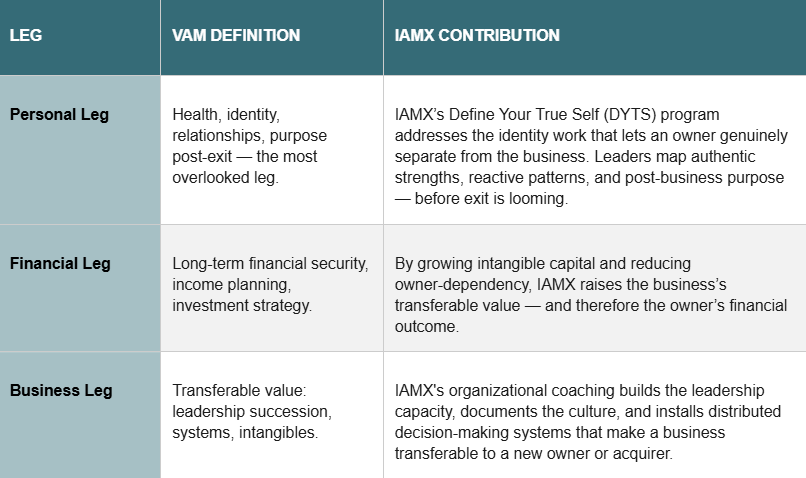
The alignment between IAMX and the VAM runs through every layer of the methodology. Below is a structured mapping of each VAM concept to the specific IAMX work that supports, accelerates, or solves it.
1. The Three Legs of the Stool
VAM’s foundational analogy requires that the Personal, Financial, and Business legs all be equally developed. IAMX works directly on the leg that consistently wobbles most.
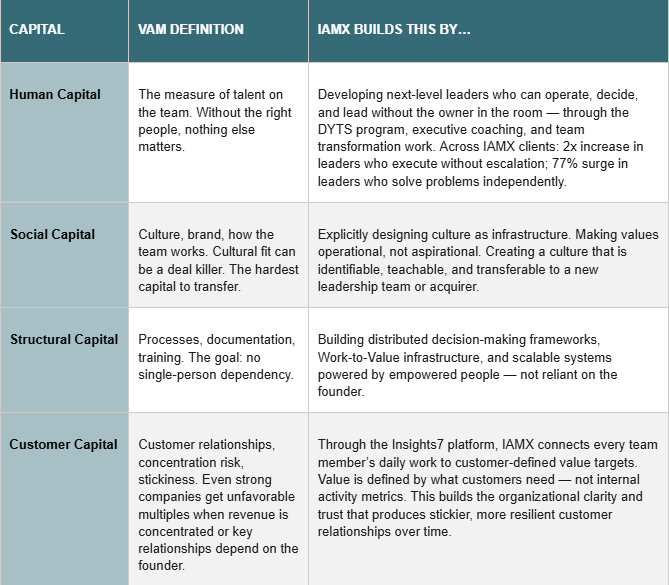
2. The Four Intangible Capitals
Intangible capitals represent roughly 80% or more of a business’s value. IAMX is purpose-built to build all four.
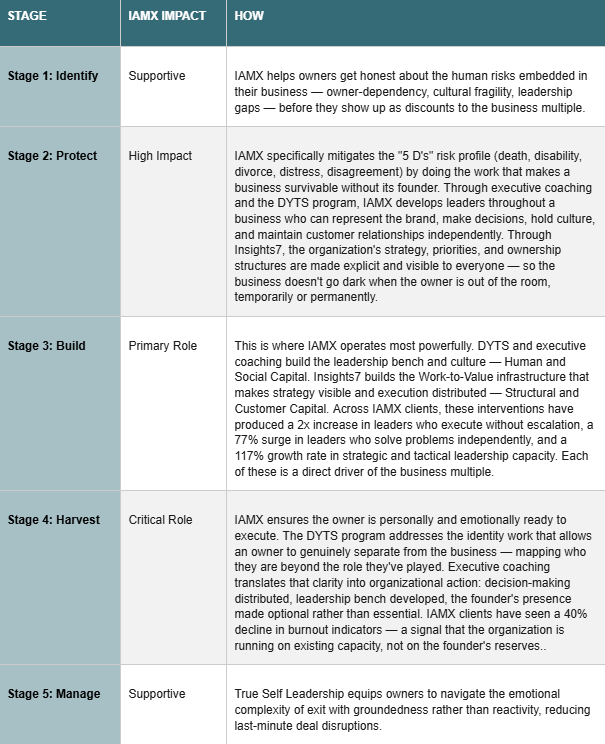
3. The Five Stages of Value Maturity
IAMX work applies across all five stages but delivers the most concentrated impact where human and organizational readiness are what slow everything down.
4. The Three Gates: Discover → Prepare → Decide
Gate 1 — Discover. IAMX can be introduced as early as the Discover Gate as a proactive mitigation of the human risks the assessment uncovers. When the owner assessment reveals owner-dependency, leadership gaps, or cultural fragility — IAMX is the referral that directly addresses those findings.
Gate 2 — Prepare: IAMX’s Home. The Prepare Gate is where IAMX delivers its highest ROI within the VAM framework. The VAM explicitly calls out two critical Prepare Gate objectives: mitigating risk and reducing owner-dependency. Both are IAMX’s core deliverables. Owner-dependent businesses “will never reach full value potential, because most of the value is locked in the owner.” IAMX systematically unlocks that value through a sequenced intervention: first developing the leaders around the owner — through DYTS and executive coaching — so they can think strategically, make decisions autonomously, and hold the culture without the founder in the room; then installing Work-to-Value infrastructure through Insights7, so strategy, priorities, and ownership are explicit and visible across the organization. The result is a business that runs on principle and process, not on personality. One client described it as "the best chapter in our company's history, both financially and in morale."
Gate 3 — Decide. The Decide Gate is where exits succeed or fail emotionally. The VAM is explicit: owners bail at the end because of cold feet — “they are scared, and have let their business become their identity while doing no personal planning.” IAMX’s True Self Leadership work is specifically designed to prevent this. Owners who have worked with IAMX arrive at the Decide Gate with a clear post-business identity, a grounded sense of purpose, and the emotional capacity to follow through.
How IAMX Delivers: The Three-Phase Journey
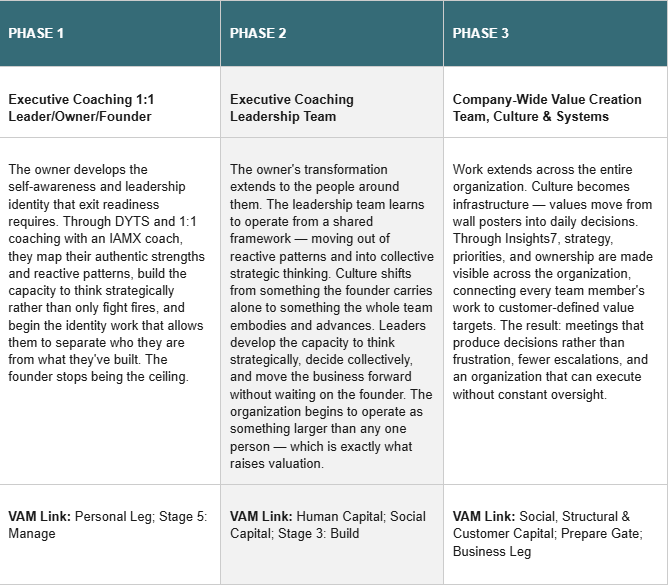
IAMX’s client work moves through three phases, each of which maps directly to VAM objectives. The work always begins with the owner and expands outward to the organization.
What Changes When IAMX Is in the Room

Is IAMX the Right Referral for Your Client?
IAMX is an ideal referral partner when your client:
• Is identified as the single point of constraint in their own business
• Has a leadership team that isn’t ready to operate without them
• Has a culture that “lives in the owner’s head” and hasn’t been documented or transferred
• Is emotionally ambivalent about exit — intellectually ready but personally hesitant
• Has weak intangible capitals that are suppressing the business multiple
• Is in the Prepare Gate and struggling to actually execute the Prioritized Action Plan
Two Methodologies, One Outcome
The VAM gives owners a strategic map. IAMX develops the human capacity to actually walk it. These are not competing approaches — each one makes the other more powerful.
An owner who hasn’t done the personal and organizational development work will struggle to execute the Prepare Gate priorities, no matter how sound the plan. A leader who has done that work with IAMX is ready — actually ready — to act on a CEPA advisor's roadmap. When both are in place, exits don’t just happen — they hold.
And when the time comes to negotiate, the work leaves behind something most sellers don't have: documented evidence of intangible value that buyers want to see — and proof of organizational strengths they didn't know to ask for.
Andy’s question — show me how this maps — reflects something real about where sophisticated exit planning is heading. The advisors who will serve their clients most completely are those who can address not just what the business is worth, but whether the humans running it are ready to let it go, and whether the organization can thrive when they do.
“VAM tells owners what to build. IAMX develops the leaders who can actually build it — and let go of it.”
Let’s Talk About Your Clients
IAMX works with growth-stage companies in the $1M–$100M revenue range — typically 20–500 people — led by technically-minded, values-driven executives navigating the terrain between founder-led chaos and scalable enterprise. Engagements typically span 6–18 months and include executive coaching, leadership development, and organizational transformation work.
If you’re working with owners in the Prepare Gate — or watching deals stall at the Decide Gate for reasons that aren’t financial — we’d welcome a conversation about how this might fit your practice and serve your clients.
A footnote: I used AI to analyze the Value Acceleration Methodology and I'm not an expert in this approach. AI can hallucinate — so if you spot an error about VAM, please let me know!
Karen Tax | Founder, IAMX
Human-First Executive Leadership & Organizational Transformation
iamx.one • karen@karentax.com