

A koan posted by someone named Dr. Sam Bayer. Not the typical productivity hacks or morning routine optimization. This was something deeper.
I left a comment. Sam replied within hours: "Thank you for the kind words! I just noticed we're both in the same city—would you be up for coffee?"
Absolutely!
When we met, I learned that Sam was a former CEO who'd successfully exited his Durham NC-based software company. Someone who'd been in the trenches. Who'd done the hard work himself of moving beyond the founder bottleneck. Now he teaches conflict resolution and negotiation—but not in the way most people teach it.
What caught my attention was how his framework aligned with something I'd been wrestling with in my own work. At IAMX, we talk about win-win outcomes all the time—creating value for yourself AND your stakeholders. But I've watched leaders struggle to see where win-win is actually possible when they're drowning in competing demands. The concept makes sense in theory but can be hard in practice.
Sam's AGENT framework gave me something concrete: a step-by-step process for finding win-win solutions under pressure.
His framework is built on a deep understanding that win-lose or lose-win scenarios mean no one actually wins. That every conflict has one of four possible outcomes, and only one of them creates collaboration and sustainable value.
I started reading his newsletter. I went to one of his workshops. And I realized something:
Every bottleneck you're experiencing as a founder—the time scarcity, the resource constraints, the decision overload—IS a logistics problem. You genuinely need better systems, clearer priorities, more capacity. But solving the logistics alone won't resolve the underlying tension: the unresolved conflict between your current capacity and your ambition, between who you've been and who the company needs you to become.
And here's what makes it feel so challenging: you're trying to negotiate your way out while your nervous system thinks you're being chased by a lion.
Let me show you Sam's win-win AGENT framework and how it supports you collaborating to sustainably scale your business.
The Story
Marcus built his SaaS company the way most founders do—by saying yes.
Yes to every customer who showed interest. Yes to custom features that would close deals. Yes to "can you just add this one thing?" requests that turned into three-month projects.
It worked brilliantly at first. His reactivity became his competitive advantage. Customers loved that he understood their specific problems. Revenue climbed from $500K to $5M in three years.
But somewhere around $5M, the engine started making strange noises.
Engineering was constantly firefighting. Features got half-built, then abandoned when the next urgent customer request came in. The product roadmap existed mostly as a beautiful fiction that everyone knew bore little resemblance to reality. Technical debt was mounting faster than the team could address it.
The VP of Engineering started every sprint planning meeting with the same exhausted question: "Which of these commitments are we actually not doing this time?"
Marcus knew he needed help. So he did what successful founders do—he hired a sales team. Three talented account executives who could take deals off his plate and accelerate growth.
Except the chaos multiplied.
Now instead of one person saying yes to custom features, there were four. Each salesperson had learned by watching Marcus close deals, so they replicated his approach perfectly: understand the customer's pain, promise the solution they need, get the contract signed.
Engineering went from managing one source of chaos to four. The VP stopped asking which commitments they weren't doing and started asking which customers they were going to disappoint this quarter.
Marcus had thought he was scaling. Instead, he'd amplified the confusion.
The natural assumption was that the sales team needed better training. Maybe they needed clearer guidelines about what to promise. Maybe they needed more oversight.
Marcus knew better. He knew where the real problem lived.
He was still the problem.
Not because he was incompetent or lazy. The opposite, actually. Marcus was so good at sales, so talented at understanding customer pain points, so skilled at customizing solutions that closed deals, that he'd built an entire sales culture in his image—scrappy and reactive.
And he'd never stopped long enough to answer two fundamental questions:
Who is our actual customer?
What job are they hiring us to do?
Without those answers, every sales conversation—whether he was in it or not—became a negotiation with no strategy. Every "yes" to a custom feature created downstream chaos. Every closed deal added complexity instead of clarity.
He knew he needed to stop. To get strategic. To define the customer segments that actually made sense. To build a coherent product vision instead of a Frankenstein collection of one-off solutions.
But he couldn't.
Revenue depended on deals closing. The sales team was finally producing. Slowing down to "get strategic" felt like choosing to lose momentum right when things were working. And honestly? He didn't trust that taking time away from deals would actually solve anything.
Inside, he was simmering. Anxious that the product was becoming unsupportable. Frustrated that engineering saw him—and now his sales team—as chaos generators. Ashamed that he'd known about this problem for months and hadn't addressed it.
"We’re having fun killing ourselves," is what he shared with me.

The truth was that Marcus didn't have a backup plan. There was no one else who could do this strategic work, no time to step away from deals while maintaining the revenue trajectory that he had promised to the board, and no clear path to slowing down without watching the business stall.
Without a BATNA—a Best Alternative to a Negotiated Agreement—he felt trapped.
But here's what Marcus hadn't realized: This wasn't a sales problem or an execution problem. It was a conflict. With himself.
Between the founder who built the company by being scrappy and reactive, and the CEO the company now needed—someone strategic enough to say no to the wrong situations for the business.
Why This Feels Impossible
Marcus's paralysis wasn't about laziness or poor time management. It was about his nervous system.
When you're operating in reactive mode—scrambling to close deals, putting out fires, responding to urgent requests—your body believes you're under threat. Your sympathetic nervous system activates. Your perspective narrows. Your brain optimizes for immediate survival, not strategic thinking.
In that state, "get strategic" feels dangerous. Your nervous system interprets slowing down as losing ground. Stepping back to think feels like letting the predator catch up. Your brain prioritizes immediate survival over strategic thinking.
That's the problem—you're trying to find strategic solutions while your body thinks you're being chased by a lion. You can't access the AGENT—the collaborative, best self, win-win part of yourself—while your body thinks you're running for your life.
Sam's AGENT framework works because it starts with the nervous system, not with negotiation tactics.
The first step isn't "clarify your position" or "understand their needs." The first step is: Become aware that you're in a conflict, and that your nervous system is running the show.
The Four Ways Out (And Why Three of Them Fail)
Sam teaches that every conflict has four possible outcomes, represented by four animals:
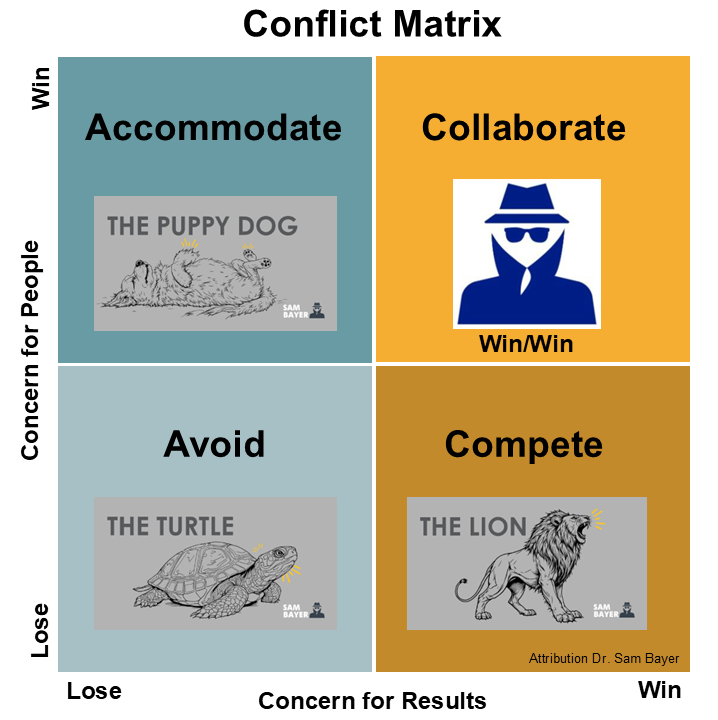
The Turtle (Avoid): Ignore the problem. Keep selling, keep saying yes, hope engineering figures it out. This guarantees the product becomes unsupportable and the best engineers leave.
The Puppy Dog (Accommodate): Give engineering whatever they ask for—more time, more resources, fewer commitments. Revenue stalls, the board gets nervous, and you're back in reactive mode trying to close deals to make up the gap.
The Lion (Compete): Force the issue. Tell engineering to execute better, tell sales to stop promising custom features, exert control through sheer will. Compliance might happen, but at the cost of trust, morale, and probably your VP of Engineering.
The AGENT (Collaborate): Recognize this as a negotiation with yourself about what role you need to play now. Get curious about what's driving the conflict—what does the scrappy founder part need? What does the strategic CEO part need? Find the collaborative solution that honors both and serves both growth and sustainability. (Yes! This is possible with help from a coach.)
Marcus found himself cycling between avoiding the strategic work (Turtle), accommodating everyone's requests (Puppy Dog), and forcing deals through despite the chaos (Lion). All three approaches came from reactive nervous system states—and none of them solved the underlying conflict.
Only the AGENT lives in responsive mode—where you can actually think strategically about what the business needs AND access reactivity as needed.
AGENT at Work
Marcus's breakthrough didn't come from working harder or hiring better. It came from recognizing he was negotiating with himself—and learning how to do it FROM a responsive state instead of a reactive one.
AWARE: Marcus had to first recognize he was in a conflict. Not with engineering. Not with his sales team. With himself. Between his old identity as the closer who built this company and the new strategic leader it now needed.
The moment he named it—"I'm in a conflict with myself about what role I need to play"—something shifted. He could breathe. He wasn't broken or failing. He was facing an internal negotiation that required intention.
GROUND: This is where Marcus did the hard work of separating emotion from fact.
What did he actually want? A company that could scale without him being the bottleneck. A product that served a clear customer segment well instead of serving everyone poorly. A sales team that could sell without creating chaos.
What did he actually need? Time away from deals to do strategic work. Someone else who could sell while he stepped back. A way to slow down without killing momentum.
What was his BATNA? This was the breakthrough question. Marcus realized he didn't have one—which is exactly why he felt powerless. So he started building alternatives. He documented his sales process. He identified which deals he actually needed to close versus which his team could handle. He blocked two days a month for strategy work, non-negotiable.
Each small step restored his sense of agency.
EMPATHIZE: This is where things got interesting. Marcus had to empathize with... himself.
The part of him that wanted to keep selling? That part built this company. That part knew how to close deals when no one else could. That part deserved respect, not shame.
The part of him that knew he needed to get strategic? That part was protecting the company's future. That part was right about the unsustainability of the current path. That part also deserved respect.
No one comes to work wanting to fail. Including the founder who's become the bottleneck.
NEGOTIATE: With clarity and empathy in place, Marcus could finally negotiate with himself about what came next.
He didn't need to stop selling entirely. He needed to sell differently—only the deals that fit a clear customer profile he'd define. He didn't need to abandon his team. He needed to give them a strategy to sell from instead of making it up as they went.
The conversation shifted from "I can't afford to stop" to "What does strategic selling actually look like?"
He carved out focused time to define customer segments and Jobs to Be Done. He involved his VP of Engineering in building a product roadmap that actually made sense for these segments. He worked with his sales team to identify which opportunities fit the strategy and which ones didn't—even if they'd close.
For the first time in months, Marcus was leading instead of reacting.
TIE: Marcus didn't just think about this differently. He changed how he operated.
He documented the customer segments and JTBD. He created a simple one-pager for the sales team: "We serve these customers by solving these problems." He scheduled monthly strategy reviews to keep refining the focus. He measured success not just by revenue closed, but by revenue that fit the strategy.
And critically—he kept building his BATNA. He cross-trained his sales team. He documented what made deals successful. He created space for someone else to eventually own sales while he owned strategy.
The win-win wasn't about harmony. It was about clarity and sustainable growth.
What This Means for Scaling
Marcus's story isn't unique. It's the pattern that plays out in every founder bottleneck.
What got you here—the hustle, the reactivity, the saying yes to everything—creates a nervous system pattern that becomes increasingly incompatible with what scaling requires.
At IAMX, we call these states Best Self (responsive) and Drama (reactive).
Best Self is when you're calm, engaged, able to see both details and context. You make better decisions. You focus naturally on what truly matters. This is where strategic thinking lives.
Drama is when perceived pressure or threat narrows your perspective. Everything feels urgent. Your attention fragments. Your nervous system is designed for immediate survival responses, not long-term planning.
The goal isn't to eliminate Drama—that's both impossible and undesirable. Drama's focused intensity is exactly what you need for immediate challenges. But here's the key: you can't move fluidly between states if you can't reliably access your responsive Best Self state in the first place.
Most leaders are so chronically stuck in Drama that they've lost the pathway back. This is why we emphasize mindfulness practices and nervous system training—not as "nice-to-haves" but as foundational capacity-building. You need a strong anchor in responsive states before you can skillfully navigate between them.
This is what we call True Self Leadership—the ability to lead from your Best Self while learning from your Drama aspects.
Sam's AGENT framework and the IAMX approach are complementary. AGENT gives you the collaborative negotiation structure. IAMX gives you the nervous system awareness that makes genuine collaboration accessible when you need it most.
Every growth stage brings new conflicts—more complexity, more people, more unknowns. Your ability to scale is limited by your capacity to access responsive states under pressure.
Marcus didn't need to work harder. He needed to work from a different nervous system state.
That's the real breakthrough.
Try It Yourself
Sam's AGENT framework isn't theoretical. It's immediately practical.
If you're facing a conflict right now—with yourself, your team, your board, your capacity—try walking through the five steps:
AWARE: Name the conflict you're in. Not the surface problem, but the actual negotiation. What are you avoiding? What feels impossible?
GROUND: What do you actually want? What do you actually need? What's your BATNA—your best alternative if this doesn't work out? If you don't have one, start building it - collaboratively!
EMPATHIZE: What does the other party need? (Even if the other party is a different part of yourself.) What positive intent can you assume?
NEGOTIATE: What's the win-win? Not the compromise where everyone loses a little, but the creative solution that serves both parties' interests?
TIE: Document it. Monitor it. Define what happens if it breaks.
Sam has created an AGENT AI chatbot that can walk you through this process for any conflict you're facing. He's also developing a comprehensive course to teach the methodology in depth.
His work comes from decades of experience—first as a CEO who successfully scaled and exited his own company, then as someone dedicated to teaching others how to navigate the conflicts that scaling inevitably creates.
You can learn more about Sam and the AGENT framework at winwinagent.org.
The Conflicts You're Avoiding
The time scarcity isn't going away. The decision overload isn't going away. The delegation struggles aren't going away.
These aren't bugs in your system. They're features of growth.
They're also negotiations. Between competing needs. Between what matters now and what matters long-term. Between the leader you've been and the leader you're becoming.
The question isn't whether you'll face these conflicts. The question is whether you'll face them from a reactive state that keeps you stuck, or a responsive state that lets you find the win-win.
Because the conflicts you're avoiding? They're not obstacles to scaling.
They're the curriculum.